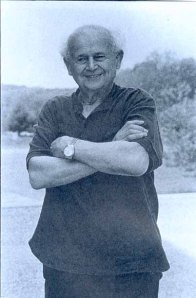
“What I’m after isn’t flexible bodies, but flexible brains. What I’m after is to restore each person to their human dignity. ” Dr. Moshe Feldenkrais
Making music is the act of transforming movement into sound. All instrumental technique (and vocal) is small, refined, coordinated movement. Wouldn’t it make sense, then, for musicians to not only study instrumental technique, but to learn how to move with greater ease, fluidity and elegance? There is no separation between the ease and beauty of the gesture and the ease and beauty of the sound that comes out of the instrument.
The Feldenkrais Method is a tremendous complement to our work as musicians. It enables us to connect with our bodies, with our potential for easier, more efficient movement and it can give us the keys to overcoming limitations, essential elements that are often missing in our instrumental training.
We have all had those experiences when you pick up your instrument and play and everything flows and responds exactly as you wish – it is effortless, beautiful and free. But there are also those times when one tries to play and nothing seems to work the way you know it can and you have the impression that your body is working against you. Feldenkrais teaches us how to cultivate and call upon that “best playing self” so that one can experience greater joy and fulfillment in music.
There are so many techniques and methods out there nowadays to help one feel better in one’s body. Many of them overlap and we often find some of the same principles in many different practices. Feldenkrais himself was highly trained in Judo, well aware of Yoga and the Alexander Technique, Ericksonian Hypnosis, and generally curious about anything and everything that claimed to help human beings live better.
Although it is always a very personal question and no method is right for everyone, The Feldenkrais Method® is extraordinarily well adapted to the needs of musicians.
– It is a method which empowers the musician to become autonomous and find his/her own solutions.
– It works directly on habitual behavior; this is very important for musicians who often have difficulty getting over blocks in their technique or playing because of habits.
– It is created by a scientist and doesn’t have any spiritual, religious, or esoteric connotations which could alienate or clash with people’s natures or beliefs.
– There is no model to follow, no technique “to master” (musicians generally have enough of this already in their musical training, no need to add more!)
– It teaches movement, how to move better, which is at the base of all music making. We create sound with our instruments through movement – movement of arms and fingers, or a breathing movement from the diaphragm… it all begins with movement, so doesn’t it make sense to study how to move better?
– It teaches how to learn more efficiently and how to creatively get past obstacles.
– It teaches how to be aware and “listen” to what’s going on in your movements and actions, helping to prevent injury or physical problems linked to playing an instrument.
– It puts students back in touch with making learning fun, pleasurable, effortless, and easy which is something that helps to counterbalance the pressures and high-demands of making music.
– The lessons are structured in a similar way to music, making a lot of sense to the way musicians think.
 Feldenkrais for Musicians
Leave a comment